
LLMs Are Yesterday’s News: The AI Pioneers Building World Models
While some are still wondering about LLMs, the AI research community has already moved on. The problem with LLMs? They predict text. They don't understand reality ( No concept of physics, Can't plan multi-step actions, Don't understand cause & effect) Enter: WORLD MODELS : AI that doesn't just write about the world, it simulates it.
Lisa Medrouk

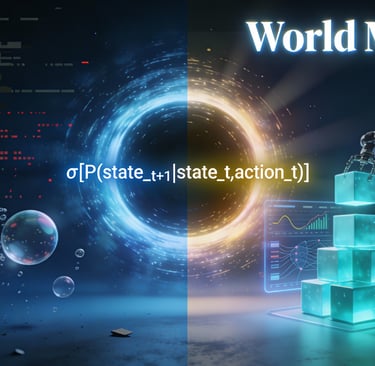
While some are still wondering about LLMs, the AI research community has already moved on.
LLMs: Brilliant But Stuck in 2D Text
Large language models transformed AI from niche research to mainstream sensation. By predicting the next word in a sequence with unprecedented accuracy, they’ve powered chatbots that write essays, debug code, and even mimic famous authors. Yet their foundation based on statistical pattern matching from text corpora, creates fundamental blind spots.
They hallucinate facts, struggle with consistent multi-step reasoning, and can’t grasp physical reality. When tasks demand understanding gravity, object permanence, or causal chains, errors cascade like dominoes. #Yann LeCun, deep learning pioneer, labels this the “herd effect”: Silicon Valley’s collective obsession with scaling LLMs blinds it to dead ends ahead.
World Models: AI That Thinks in 3D Reality
World models represent a paradigm leap: AI systems constructing internal simulations of reality to forecast outcomes and plan actions. Imagine an AI not just describing a room but mentally modeling every object’s position, predicting how they interact if pushed, and charting safe navigation paths, all before moving a finger.
Consider these three scenarios:
1. Robotics: A warehouse bot simulates box stacking physics, avoidin collapses.
2. Finance: A trading agent stress-tests portfolios under simulated market crashes.
3. Gaming: An NPC anticipates player dodges, setting dynamic ambushes.
LLMs autocomplete text; world models simulate worlds.
Yann LeCun’s Wake-Up Call
Few carry more credibility than Yann LeCun. Co-inventor of convolutional neural networks, Turing Award recipient, and decade-long Meta Chief AI Scientist, he laid groundwork for today’s deep learning boom. Now at his startup AMI Labs, LeCun declares LLMs insufficient for human-level intelligence.
His diagnosis: without planning, LLMs can’t evaluate action consequences. They predict words, not world states. Billions spent scaling parameters yield diminishing returns for true autonomy. AMI Labs targets joint embedding predictive architectures, world model precursors enabling foresight.
Fei-Fei Li’s $5B Bet on Spatial Intelligence
Fei-Fei Li, ImageNet creator who ignited the vision revolution, leads the charge commercially. Her World Labs builds Large World Models (LWMs) generating editable 3D environments from text, images, or video. Their Marble system uses 3D Gaussian splatting for hyper-realistic simulations. That can perceive, generate, reason and interact with the 3D world
In January 2026, World Labs entered funding talks for $500M at a $5B valuation, a 5x leap from Series A. Backers like a16z and Nvidia see spatial intelligence powering robotics, AR/VR, and enterprise planning. Li positions LWMs as the post-LLM infrastructure layer.
Other AI Luminaries Championing World Models
David Ha kickstarted the modern wave with his seminal 2018 “World Models” paper, demonstrating RL agents learning compact reality compressions for efficient planning. Jürgen Schmidhuber, recurrent neural net pioneer, laid philosophical foundations through “artificial curiosity” driving predictive world understanding since the 1990s. DeepMind’s Genie 2 team generates fully interactive game worlds from single screenshots, training agents in emergent environments. UC Berkeley’s Sergey Levine advances robotics world models via DreamerV3, blending imagination with real-world execution for dexterous manipulation.
These luminaries converge: world models unlock embodiment, where LLMs merely narrate.
The 2026 Paradigm Shift
Consensus builds: hybrid architectures prevail, LLMs for language, world models for cognition. Key enablers include model-based reinforcement learning (learning policies via simulated rollouts), predictive coding (hierarchical world compression), and multimodal dynamics (fusing vision/motion/text).
What This Means for Builders
The world model revolution demands hands-on experimentation. Stop tweaking LLM prompts, start building predictive simulators.
Here’s an actionable roadmap for developers, with 3 World Model Starter Projects. These leverage open-source frameworks for rapid prototyping, bridging theory to production-grade agents.
1. Robotics Gym: FetchReach with DreamerV3 (MuJoCo Playground)
Goal: Train a robotic arm to reach/pick objects in simulated physics, transferable to real hardware.
Stack: MuJoCo Playground (pip install playground) + DreamerV3 (github.com/danijar/dreamerv3). Use MJX for GPU-accelerated sim-to-real on quadrupeds/hands/arms.
2 Market Sim: Portfolio Stress-Testing with World Labs API
Goal: Generate dynamic market environments for trading agent training.
Stack: World Labs World API (worldlabs.ai/api, beta access) + custom RL env.
3 Game Agent: NPC Training with DeepMind Genie 3
Goal: Create interactive worlds for agent evaluation.
Stack: Genie 3 playground (genie3.cloud/tutorial) or open recreations.
The Global Stakes
LeCun warns America’s proprietary pivot cedes ground to China’s open-source dynamism. EU’s AI Act grapples with agent autonomy, demanding verifiable simulations. 2026 dawns as the world model race, enterprise spend shifting 60% to agentic systems by 2027.
The field accelerates, but direction matters. Will you chase text tokens or master reality itself?