Europe’s AI Sovereignty Dilemma: EU AI Act vs. US Cloud Dominance
Can Europe regulate AI responsibly while depending on American hyperscalers for infrastructure? A governance perspective on compliance risks and solutions.
Lisa Medrouk

Can Europe Regulate AI While Relying on US Cloud Giants?
Europe faces a tricky challenge: how do you enforce strict AI rules when most of your digital infrastructure sits on American soil? With the EU AI Act now in force as of 2026, this question has moved from theoretical to urgently practical.
The Core Problem
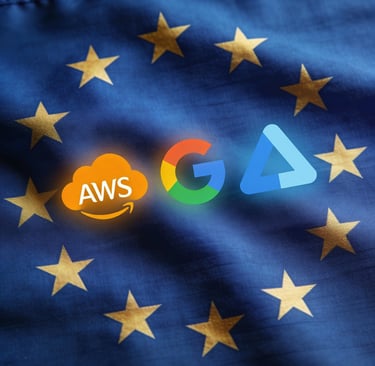
Here’s the tension in a nutshell. The EU has built one of the world’s most comprehensive AI governance frameworks, complete with requirements for transparency, risk assessments, and human oversight. Yet over 60% of European cloud infrastructure runs on US hyperscalers, #AWS, #Azure, and #Google Cloud. These platforms fall under US jurisdiction, including laws like the CLOUD Act that allow American authorities to access data stored on US providers’ servers, even when those servers are located abroad.
This creates what we might call a compliance paradox. European organizations must follow stringent EU rules for their AI systems, but those systems often run on infrastructure subject to a completely different legal regime. It’s a bit like trying to enforce your home’s house rules when half your furniture is technically owned by someone else.
What’s Driving This Dilemma?
Several factors contribute to Europe’s predicament:
Legal conflicts are brewing. US extraterritorial laws potentially clash with both GDPR data protection requirements and the EU AI Act’s systemic risk controls. The EU Cybersecurity Certification Scheme for Cloud Services (EUCS) has stalled over disputes about sovereignty requirements. Some experts argue that imposing mandatory EU data storage through EUCS implementing regulations oversteps legal authority under the EU Cybersecurity Act and could unfairly limit innovative third-country providers. They suggest that sovereignty concerns should be addressed through primary legislation by EU lawmakers, while EUCS should first tackle fundamental cybersecurity standards.
Market dependency runs deep. European cloud spending flows disproportionately to American providers, starving potential homegrown alternatives of investment. Recent reports suggest that 68% of European businesses struggle with EU AI Act compliance due to infrastructure limitations.
Policy is playing catch-up. While initiatives like Gaia-X aim to create federated cloud ecosystems that respect data sovereignty, they’re scaling slowly compared to the relentless growth of US hyperscalers.
How Europe Is Responding
European policymakers aren’t sitting idle. Several initiatives are underway:
The Cloud and AI Development Act (CADA) is expected in 2026 and aims to triple EU-owned AI compute capacity. It will also establish eligibility criteria for public-sector cloud procurement that favor providers under European jurisdiction.
Sovereign cloud certifications like EUCS and various national schemes are certifying European providers such as OVHcloud and Deutsche Telekom’s cloud services. These certifications ensure data stays within EU borders and that foreign governments can’t access it without EU oversight. French provider S3NS has recently entered the SecNumCloud qualification process, expanding options for organizations handling sensitive AI workloads.
The EuroStack initiative is developing an open-source cloud stack designed for EU compliance from the ground up, reducing dependency on proprietary American systems.
Practical Steps for Compliance
If you’re navigating these waters, here are some strategies to consider:
Map your AI risks carefully. Conduct jurisdiction audits across your AI pipelines to understand where your data lives, which laws apply, and what backup options exist for high-risk systems like biometric identification or critical infrastructure AI. Build contractual protections into your provider agreements, requiring commitment to EU AI Act obligations including model transparency and incident reporting. Consider multicloud architectures that use sovereign clouds for regulated workloads while leveraging hyperscalers for non-sensitive computing tasks. Plan for portability by adopting standards like those from Gaia-X to maintain interoperability and avoid vendor lock-in.
Strengthen your governance frameworks. Align with standards like ISO/IEC 42001 for AI management systems while integrating EU AI Act requirements. If you operate across the Atlantic, consider incorporating the NIST AI Risk Management Framework to bridge different regulatory approaches.
What This Means for Governance Professionals
For those of us working in AI ethics and compliance, the message is clear: sovereignty needs to be baked in from day one, not bolted on later. Watch for EUCS Level 3 certifications and CADA procurement rules as they’ll fundamentally reshape vendor selection in both public and private sectors.
The bigger picture? Europe is shifting from a purely regulatory stance to building genuine resilience. The goal isn’t just to write rules but to create infrastructure that enables innovation without sacrificing autonomy. It’s a long game, but one that could redefine how democratic societies govern transformative technologies.