
Why Your Compliant AI Pilot Still Dies Before Production
The hidden chasm between compliance approval and real-world deployment and what actually works
Lisa Medrouk
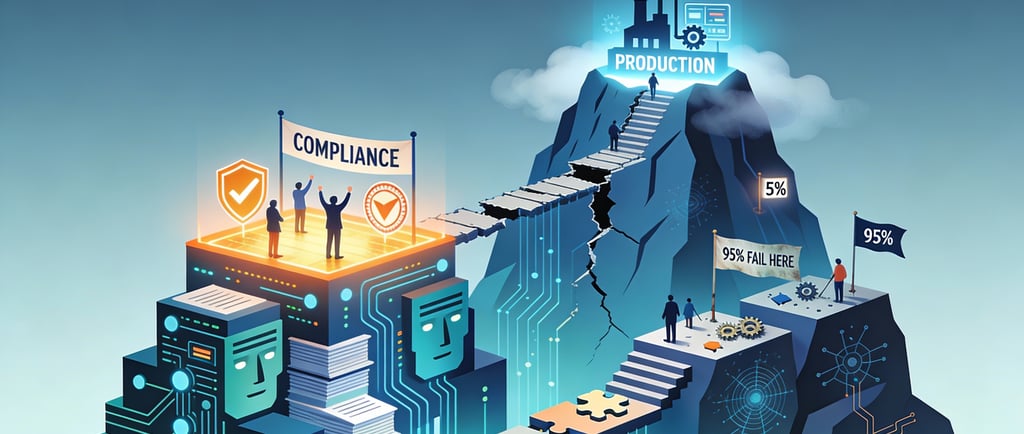
The boardroom presentation went flawlessly. Your AI proof of concept demonstrated impressive accuracy on test data. Risk assessments satisfied the compliance team. The governance review board stamped their approval. Leadership greenlit the next phase.
Fast forward six months: the project sits in limbo, technically sound but operationally stalled.
If this sounds familiar, you’re not alone. MIT research analyzing over 300 enterprise AI initiatives uncovered a startling reality: only 5% of custom AI pilots ever reach production deployment. The dropout pattern is brutal — 60% of organizations evaluate AI solutions, 20% advance to pilot stage, but just 5% successfully deploy at scale (MIT NANDA, 2025).
The most striking finding? This failure rate persists even after projects clear compliance reviews specifically designed to validate safety, fairness, and operational readiness.
Compliance has become what climbers call a “false summit” a point that looks like the destination but actually marks the beginning of the most treacherous terrain. Teams celebrate regulatory approval, only to watch their initiatives sink into what frustrated executives now call “pilot purgatory.”
This article examines why compliance success doesn’t predict production readiness. Drawing on systematic analysis of 300+ public AI implementations, structured interviews with 52 organizations, and survey data from 153 senior leaders, we’ll map the hidden obstacles that separate the 5% who succeed from the 95% who don’t.
The AI Production Gap: Defining the Problem
Before unpacking why AI projects fail after compliance, we need clarity on what we mean by failure.
A proof of concept (PoC) demonstrates technical feasibility on curated data. A pilot tests the system with real users in a controlled environment. Production deployment means the system operates at scale, integrated into daily workflows, delivering measurable business outcomes.
The gap between these stages is staggering. Industry data shows that approximately 88% of AI pilots fail to reach production. But here’s what makes this particularly troubling: many of these failures occur after clearing compliance hurdles specifically designed to ensure systems are safe, fair, and operationally sound.
Compliance frameworks like the EU AI Act serve vital functions, establishing risk thresholds, requiring transparency, mandating documentation. Organizations invest heavily in these processes, often taking months to shepherd pilots through internal reviews and regulatory assessments. Yet passing these gates proves little about whether a system can actually survive contact with production reality.
The Compliance Illusion: Documentation ≠ Operational Resilience
Compliance reviews validate your risk management story. They verify you’ve documented potential harms, classified your system appropriately, and articulated mitigation controls.
What they don’t validate:
Performance under chaos: Standard compliance tests rarely expose edge cases, adversarial inputs, or the data quality issues that emerge when your carefully curated pilot dataset meets messy production reality. Your model might excel at the sanitized examples used for compliance validation while failing spectacularly on the inconsistent, incomplete data flowing through actual operational systems.
Integration viability: That elegant API you built for the pilot? It probably relies on manual data exports, hard-coded file paths, and assumptions about data availability that evaporate when you try to integrate with legacy infrastructure. Compliance reviews assess risk documentation, not whether your system can actually plug into a 15-year-old CRM without breaking.
Operational sustainability: Compliance frameworks evaluate point-in-time snapshots. They don’t stress-test whether you have the monitoring infrastructure to detect model drift, the processes to retrain systems when performance degrades, or the incident response procedures to handle failures at scale.
This creates a dangerous confidence gap. Teams believe they’re deployment-ready when they’ve merely cleared administrative hurdles. Leadership assumes compliance approval means production viability. Both are wrong.
The result: projects that look beautiful on paper die quietly in the gap between approval and implementation.
The Ownership Void: When Everyone’s Responsible, No One Is
Here’s a pattern that emerged consistently across dozens of enterprise AI initiatives:
Innovation teams build the PoC. Data scientists optimize the model. Compliance officers shepherd it through review. External consultants provide specialized expertise. Everyone executes their mandate brilliantly.
Then comes the handoff to production and suddenly, there’s no one to hand it to.
The innovation team has already pivoted to the next pilot. The consultants’ contract ended after compliance approval. The compliance function fulfilled its role by validating documentation. The IT operations team, who will actually need to deploy and maintain this system, was barely involved during the pilot phase and has no capacity to absorb new responsibilities.
Meanwhile, business stakeholders who funded the initiative have grown frustrated by timeline slippage. Executive sponsors have shifted attention to more immediately rewarding projects. Budget holders question ROI calculations that assumed rapid deployment but now face indefinite delays.
The AI project becomes an orphan technically viable, compliance-approved, and utterly stalled.
Research shows that organizations achieving successful deployments establish cross-functional ownership from day one. They assign a dedicated leader who owns the system from conception through production and ongoing operations, with authority spanning business strategy, technical development, compliance, and operations.
Without this structural accountability, projects drift into indefinite “we’ll get to it next quarter” status. The compliance review becomes a milestone that marks the end of organizational momentum rather than the beginning of deployment.
Data Reality Check: From Curated to Operational
Your PoC ran on beautifully prepared data. Someone spent weeks cleaning it, standardizing formats, resolving inconsistencies. For the pilot, data teams pulled specific datasets, merged siloed databases, and created custom pipelines.
Now try to operate that process.
Suddenly you’re confronting realities that compliance reviews never surfaced:
The governance nightmare: Those datasets you unified for the pilot? They’re owned by three different business units with conflicting access policies. Getting production-level access requires navigating data governance committees that meet quarterly. Privacy regulations that seemed manageable in the abstract now require complex consent workflows and data handling procedures that weren’t modeled during compliance assessment.
The quality decay problem: Training data was historical, carefully validated and cleaned over time. Production data arrives in real-time, riddled with null values, inconsistent formats, and unexpected inputs that nobody anticipated. The model that achieved 94% accuracy on compliance test sets crashes to 67% accuracy on actual operational data.
The integration complexity: Your pilot used batch processing with manual data preparation steps. Production requires real-time integration with systems that can’t be modified, databases with incompatible schemas, and APIs with rate limits that make your planned architecture unworkable.
Building production-ready data infrastructure isn’t just harder than building a PoC, it’s a fundamentally different engineering challenge. Yet compliance reviews rarely assess whether organizations have the data engineering capability, governance maturity, and infrastructure investment required to sustain production deployment.
The Skills Mismatch: Researchers Build Pilots, Engineers Deploy Systems
The team that successfully built your PoC probably included talented data scientists and researchers. They excel at model development, experimentation, and proving concepts.
Production deployment demands entirely different competencies:
MLOps expertise to build automated training, testing, and deployment pipelines. DevOps capabilities to integrate AI systems with existing infrastructure and ensure reliability. Security specialists who understand AI-specific vulnerabilities and attack vectors. Monitoring engineers who can detect model drift, performance degradation, and system anomalies in production environments.
Recent research reveals that organizations consistently underestimate this skills gap. Data scientists who built the prototype typically have neither the interest nor expertise to operationalize it. The engineering talent needed for production deployment is scarce, expensive, and usually committed to keeping existing systems running.
This creates a brutal bottleneck: your compliance-approved model sits idle while you search for engineering capacity to deploy it properly. Even when you find the talent, they often discover that the pilot was built using patterns that don’t scale, requiring partial or complete rebuilds to meet production requirements.
The most successful organizations address this by involving production engineering teams from the PoC stage, ensuring that pilots are built using production-grade tools and practices even if it slows initial development. The time lost upfront gets recovered tenfold by avoiding the “rebuild from scratch” phase that kills most post-compliance projects.
The Governance Paradox: Safety Requires Oversight, Deployment Requires Velocity
AI governance exists for excellent reasons. We need oversight frameworks that ensure safety, fairness, and accountability. Compliance reviews catch potential harms before they reach production.
But here’s the paradox: the very governance structures that make AI safer can also make it impossibly slow to deploy.
Review cycles stretch timelines: Each compliance checkpoint — model review, security assessment, privacy impact analysis, fairness evaluation — adds weeks or months to deployment schedules. Research tracking enterprise AI initiatives found that organizations take an average of nine months or longer to move from pilot to production, with much of that time consumed by governance processes.
Documentation requirements consume resources: Teams invest enormous effort creating compliance artifacts: model cards, risk assessments, transparency reports, audit trails. This work is necessary, but it diverts capacity from actually building production-ready systems. Engineers spend more time documenting than engineering.
Risk aversion freezes progress: In organizations with strong compliance cultures, fear of regulatory violations or reputational damage can paralyze decision-making. When in doubt, teams delay deployment indefinitely. One enterprise CIO summarized this dynamic: “We’ve created a culture where no one gets fired for blocking an AI deployment, but you might get fired if a deployment goes wrong. The incentives push everyone toward perpetual caution.”
This creates a lose-lose scenario: rushed deployments skip essential safety checks, while thorough governance processes stall potentially beneficial systems. Finding the right balance requires mature organizational capability that most companies are still developing.
The organizations successfully navigating this paradox treat compliance as an ongoing practice rather than a one-time gate. They build feedback loops, continuous monitoring, and incremental validation into their deployment processes, allowing them to move faster while maintaining appropriate oversight.
The Expectations Gap: Pilots Promise Transformation, Production Delivers Incremental Gains
Be honest: when your organization greenlit this AI initiative, what were the promised outcomes?
Transform customer experience? Revolutionize operations? Deliver 10x efficiency gains?
Now consider what production AI actually delivers: incremental improvements in specific workflows. Modest accuracy gains over existing processes. Operational benefits that accumulate slowly over time rather than arriving as dramatic breakthroughs.
This expectations mismatch kills projects that are technically successful but commercially underwhelming. Leadership funded the pilot expecting transformation. When they see steady but unspectacular results after compliance approval, they lose enthusiasm.
Research examining AI deployment outcomes found that while generic tools like ChatGPT show high adoption rates for simple tasks, only 5% of custom enterprise systems reach production because they fail to deliver the dramatic ROI that justified initial investment.
The ROI calculations that supported the pilot assumed rapid deployment and immediate impact. Months of post-compliance delays erode that business case. By the time the system could theoretically go live, the budget has been reallocated and the executive sponsor has moved on to more promising initiatives.
Misaligned expectations don’t just create disappointment, they actively prevent successful AI deployments from crossing the finish line. The organizations achieving production deployment set realistic expectations from the start, framing AI as a tool for incremental improvement rather than magical transformation.
What Actually Works: A Holistic Path from Compliance to Production
Bridging the PoC-to-production gap requires treating compliance as one milestone in a comprehensive deployment journey, not the climax of the story. Organizations successfully reaching production share common practices that address the failure modes outlined above.
Design for Production from Day One
Stop treating PoCs as standalone experiments. Before building your pilot, map the complete deployment journey: What infrastructure will you need? Which teams must be involved? What governance processes will apply? Which integration points are critical?
Build your PoC using production-grade tools and practices, even if it slows initial development. Use versioned datasets, automated testing, proper monitoring, and infrastructure that can scale. Yes, this feels like premature investment. No, you won’t regret it when you’re ready for production.
Research tracking deployment success rates shows that organizations involving operations, security, and compliance teams from the PoC stage achieve production deployment at roughly twice the rate of those treating pilots as pure research exercises.
Establish Cross-Functional Ownership Early
Assign a deployment leader before the pilot begins: someone who will own the system from conception through production and ongoing operations. This person needs authority across functions: business strategy, technical development, compliance, and operations.
Create shared success metrics that align all stakeholders. If data science is measured on model accuracy while operations is measured on system uptime and business teams on ROI, you’ve built structural conflict into your deployment process.
The most successful deployments have steering groups with representatives from business, engineering, compliance, and operations, meeting regularly throughout the pilot phase to address integration challenges, governance requirements, and operational readiness in parallel rather than sequentially.
Invest in Infrastructure Before You Need It
Don’t wait until post-compliance to build MLOps capabilities. Invest in automated testing, deployment pipelines, and monitoring systems while developing your PoC.
Particularly critical: data infrastructure. Build governed, accessible, production-quality data pipelines from the start. The dataset you use for your pilot should be a subset of your production data, not a specially curated alternative universe that bears little resemblance to operational reality.
Organizations that invest early in this infrastructure report faster deployment timelines and fewer post-compliance surprises. Those that defer infrastructure investment find themselves stuck in lengthy “endless-production” phases that kill momentum and executive support.
Embed Continuous Governance, Not Checkpoint Governance
Move beyond compliance checklists toward continuous governance that emphasizes real-world performance. Instead of asking “did we document the risks?”, ask “are we monitoring for those risks in production? Do we have response procedures when issues arise?”
Build feedback loops that involve actual users and affected stakeholders throughout development, not just during compliance review. Their insights surface issues that formal assessments workflow mismatches, edge cases, and integration challenges that determine whether systems actually get used after deployment.
The most mature organizations implement monitoring systems that track model performance, detect drift, identify bias, and flag anomalies from day one of production deployment. They establish procedures for model retraining, updating, and decommissioning, and they budget for these ongoing operational costs upfront.
Partner Strategically Rather Than Building Everything
Research examining build-versus-buy decisions for AI systems reveals a striking pattern: external partnerships with learning-capable, customized tools reach deployment approximately 67% of the time, compared to 33% for internally built tools.
This doesn’t mean organizations should never build. It means they should be realistic about internal capabilities and willing to partner where external expertise can accelerate deployment and reduce risk.
The most successful buyers treat AI vendors like business service providers rather than software vendors, demanding deep customization aligned to internal processes, benchmarking tools on operational outcomes rather than model performance, and partnering through early-stage failures while treating deployment as co-evolution.
Focus on Back-Office ROI, Not Just Front-Office Visibility
While approximately 50% of AI budgets flow to sales and marketing functions, some of the most dramatic cost savings documented in recent research came from back-office automation that replaced external spending rather than internal headcount.
Organizations achieving production deployment report measurable value including BPO elimination generating millions in annual savings, agency spend reduction of 30% or more through automated content and creative work, and risk management cost reductions through automated compliance checks and monitoring.
These gains often deliver faster payback periods and clearer cost reductions than front-office initiatives, yet they receive less investment because the ROI is harder to attribute to specific initiatives and less visible to executive leadership.
Moving Beyond Pilot Paralysis
The journey from PoC to production isn’t primarily a technical challenge, it’s an organizational transformation that requires aligning business strategy, technical infrastructure, governance frameworks, and change management.
Compliance reviews play an essential role in that transformation, ensuring AI systems meet safety and fairness standards. But passing compliance doesn’t make a system production-ready any more than passing a driving test makes someone a professional race car driver.
The 95% failure rate isn’t inevitable. It’s the predictable outcome of treating AI deployment as a purely technical or compliance exercise rather than the holistic organizational challenge it actually represents.
Organizations successfully crossing this chasm share a common characteristic: they treat AI deployment as a strategic capability to build, not a series of projects to complete. They invest in people, processes, and infrastructure needed to operationalize AI before launching pilots. They measure success by production impact, not prototype performance.
Your next AI project doesn’t have to join the 95%. But avoiding that outcome requires acknowledging an uncomfortable truth: compliance approval is just the beginning of the real work. The organizations that recognize this early, structure for it deliberately, and execute on it persistently are the ones extracting millions in value while their competitors celebrate compliance checkpoints on projects that will never see production.
If you’re leading AI initiatives in your organization, ask yourself: How many of your “successful” pilots are actually in production? How many are compliance-approved but operationally stalled? And what will you do differently with the next one?